Camera lens types confuse more beginners than any other part of photography — and for good reason. You are standing in a camera store or scrolling through Amazon looking at rows of metal cylinders with identical glass fronts, all labelled with numbers that mean nothing yet.
The right lens changes your photos more than the camera body itself. Understanding the main camera lens types is the single fastest way to improve your results without spending more money. This guide covers every type clearly — what each one does, when to use it, and which to buy first.
The Two Fundamental Camera Lens Types
Before covering individual lens categories, one distinction matters more than any other. Every camera lens is either a prime lens or a zoom lens.
Prime lenses have a single fixed focal length — 35mm, 50mm, 85mm. They do not zoom. The trade-off is that they are optically sharper, lighter, and have wider maximum apertures than zoom lenses at equivalent prices. They force you to move your feet to change your composition, which many photographers argue makes you think more carefully about framing.
Zoom lenses cover a range of focal lengths — 24-70mm, 70-200mm, 18-55mm. They offer flexibility without changing lenses. They are heavier and slower (smaller maximum aperture) than equivalent prime lenses, but the convenience factor is significant for travel, events, and any situation where swapping lenses between shots is impractical.
Most photographers start with a zoom lens for versatility and add prime lenses as they identify which focal lengths they use most. This is still the smartest approach for most people.
Camera Lens Types by Focal Length
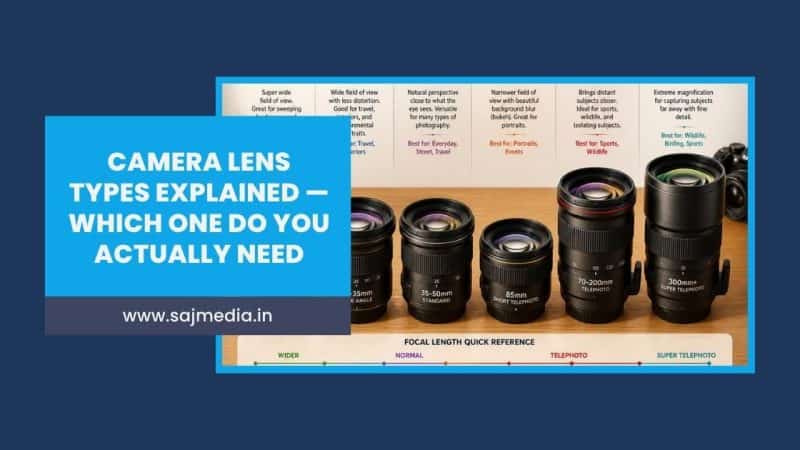
Focal length is measured in millimeters and determines how wide or narrow your field of view is. A lower number means a wider view — more of the scene fits in the frame. A higher number means a narrower view — distant subjects appear larger and closer.
Wide Angle Lenses — 14mm to 35mm
Wide angle lenses see more of the scene than the human eye does. They are the natural choice for landscapes, architecture, interiors, and any situation where fitting more into the frame matters more than isolating a subject.
The exaggerated perspective of wide angle lenses makes nearby subjects look large and imposing while pushing the background further away. This distortion is a feature in landscape photography and a liability in portrait photography — faces photographed at 14mm or 16mm look distorted and unflattering.
Best use cases: Landscape photography, architecture and real estate, interior photography, travel photography when you want context and environment, environmental portraits where the location is as important as the subject.
Recommended starting focal length: 24mm or 28mm on a full-frame camera. On an APS-C crop sensor camera, 16mm or 18mm produces an equivalent field of view. As covered in the mirrorless vs DSLR guide, your sensor size directly affects how a given focal length actually behaves.
Standard Lenses — 35mm to 70mm
Standard lenses — sometimes called normal lenses — produce a field of view close to what the human eye sees naturally. The classic standard focal length is 50mm on a full-frame camera. It looks natural without exaggerating perspective in either direction.
The 50mm prime lens is consistently recommended as the best first lens purchase for photographers on a budget. It is available in f/1.8 versions from Canon, Nikon, and Sony for under $250 — producing beautiful shallow depth of field at a fraction of what zoom lenses with equivalent apertures cost.
Best use cases: Street photography, travel, documentary work, environmental portraits, general everyday photography, food photography, and as a walk-around lens for photographers who want simplicity.
The 35mm alternative: On a full-frame camera, 35mm gives a slightly wider, more environmental view than 50mm while remaining in the standard range. Many documentary and street photographers prefer 35mm for its slightly wider perspective that includes more context around the subject. On crop sensor cameras, a 24mm lens produces the equivalent field of view.
Telephoto Lenses — 70mm to 300mm and Beyond
Telephoto lenses bring distant subjects closer. The most significant secondary effect of telephoto focal lengths is compression — objects at different distances appear closer together in the frame, giving backgrounds a distinctly different look compared to wide angle lenses.
This compression effect is why portrait photographers love the 85mm to 135mm range. Backgrounds blur beautifully at longer focal lengths, and facial features are rendered naturally without the distortion of wider lenses.
Short telephoto (70mm to 135mm): The portrait photographer’s range. Comfortable working distance from the subject, natural facial rendering, beautiful background separation. The 85mm f/1.8 is one of the most popular portrait lenses available at an accessible price.
Mid telephoto (135mm to 300mm): Wildlife, sports, and events where you cannot get close to the subject. Also excellent for compressed landscape shots that flatten and layer distant mountain ranges or city skylines.
Super telephoto (300mm+): Sports from a distance, birds in flight, wildlife safari photography. These lenses are large, heavy, and expensive — typically the territory of specialist photographers.
Understanding telephoto compression is particularly useful for video creators — longer focal lengths produce the cinematic compressed background look that appears in professional productions. This connects directly to camera movement techniques — a telephoto lens on a gimbal produces significantly different visual language than a wide lens in the same movement.
Macro Lenses
Macro lenses are designed to photograph very small subjects at very close distances. True macro lenses provide a 1:1 reproduction ratio — the subject appears on the sensor at the same size it is in real life. This allows extreme close-up photography of insects, flowers, jewelry, watch mechanisms, food details, and any subject where tiny textures and details are the point of the image.
Macro lenses also work as excellent portrait lenses. Most macro focal lengths fall in the 90mm to 105mm range — a comfortable portrait focal length — and the quality optics required for close-up sharpness also produce excellent results for standard portrait work.
Best use cases: Product photography, jewelry photography, food close-ups, nature and insect photography, any situation where the small details of a subject are the story.
According to Tamron’s macro lens guide, a macro lens is one of the most versatile specialist lenses available — functioning as both a dedicated close-up tool and a capable portrait lens in a single purchase.
Specialty Camera Lens Types
Fisheye Lenses
Fisheye lenses produce extreme barrel distortion — the characteristic curved, circular look that makes the world appear wrapped around a sphere. They cover focal lengths from approximately 4mm to 14mm and produce fields of view from 100 to 180 degrees.
Fisheye lenses are specialty tools rather than everyday photography equipment. They are popular in skateboarding and action sports photography, creative abstract work, and real estate photography where a full-room view in a very tight space is required.
Tilt-Shift Lenses
Tilt-shift lenses allow the photographer to tilt and shift the lens plane relative to the sensor. This produces two distinct effects: correction of perspective distortion in architectural photography, and the miniature tilt-shift effect that makes real-world scenes look like scale models.
These are specialist tools used primarily by architectural photographers and commercial imaging professionals. They are expensive and require deliberate, thoughtful use rather than fast spontaneous shooting.
Cine Lenses
Cine lenses are designed specifically for video production. They differ from photography lenses in several important ways — manual iris control with click-less operation, consistent focus breathing, calibrated focus scales for follow focus systems, and standardized front diameters for filter systems.
For video-first creators as discussed in types of shots in film, cine lenses allow the kind of precise control that photography lenses cannot match. However, they are significantly more expensive and are primarily relevant for narrative filmmaking rather than content creation.
Prime vs Zoom — Which Should You Buy First
The decision depends entirely on how you shoot.
Buy a prime lens first if: You have a clear sense of the focal length you use most, you shoot in low light regularly, you prioritize image quality and background blur over flexibility, or you are learning and want to develop compositional discipline.
Buy a zoom lens first if: You shoot a variety of subjects across different distances, you cannot swap lenses between shots, you travel with one camera, or you are still figuring out which focal lengths suit your style.
The smartest starting kit for most photographers is a kit zoom lens — typically the 18-55mm or 16-50mm that comes bundled with a new camera — plus a 50mm f/1.8 prime. The zoom handles versatility. The prime handles low light and the look you cannot get from the kit lens.
How Sensor Size Affects Lens Choice
Your camera’s sensor size changes how a given focal length actually behaves. A 50mm lens on a full-frame camera behaves like 50mm. The same lens on a Canon APS-C camera multiplies by 1.6x — behaving like an 80mm lens. On a Sony or Nikon APS-C camera, the multiplier is 1.5x — making 50mm behave like 75mm.
This crop factor affects wide angle lenses most significantly. A 24mm wide angle on a full-frame camera becomes a 38mm standard lens on an APS-C body — no longer wide at all. APS-C shooters who want wide angle photography need lenses in the 12mm to 18mm range to achieve genuinely wide results.
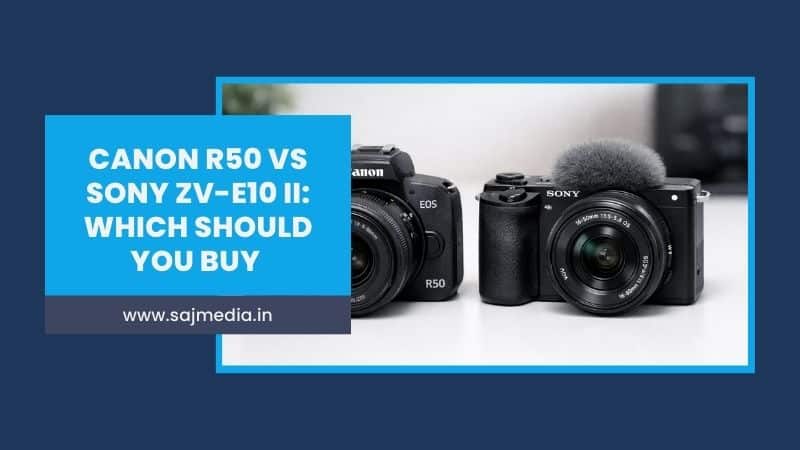
The Canon R50 vs Sony ZV-E10 II comparison covers this sensor size difference in practical terms for content creators choosing between the two most popular APS-C cameras in the market.
Building Your First Lens Kit
Rather than buying a single lens and hoping it covers everything, most photographers build a small kit progressively based on what they actually shoot.
The starter kit:
A 18-55mm or 16-50mm kit zoom covers the majority of everyday situations. Add a 50mm f/1.8 prime for portraits and low light. This two-lens combination handles most photography for most people — total additional investment around $150 to $300.
The portrait specialist kit:
35mm f/1.8 for environmental portraits with context. 85mm f/1.8 for tight headshots and flattering compression. These two focal lengths cover the full range of portrait work from wide environmental shots to close beauty images.
The travel and documentary kit:
A single 24-70mm f/2.8 zoom handles the full range of travel situations — wide enough for environments, long enough for candid moments — without requiring lens swaps in the field.
The video creator kit:
A 16-35mm or 18-35mm wide zoom plus a 50mm or 85mm prime covers the focal lengths most used in video production. As covered in the compact vlog camera guide, many vloggers default to a single wide prime for its field of view and low-light performance.
FAQ
Camera lenses are classified as prime (fixed focal length) or zoom (variable focal length), and by focal length range: wide angle (14-35mm), standard (35-70mm), telephoto (70mm+), and macro. Specialty types include fisheye, tilt-shift, and cine lenses.
A standard zoom lens in the 18-55mm or 24-70mm range is the most practical starting point. It covers wide to short telephoto focal lengths, making it suitable for most everyday situations. Adding a 50mm f/1.8 prime gives you access to wider apertures for portraits and low light.
A prime lens has one fixed focal length — it does not zoom. A zoom lens covers a range of focal lengths. Prime lenses are typically sharper and have wider maximum apertures at equivalent prices. Zoom lenses offer versatility without changing lenses.
The millimeter number on a lens is its focal length — a measure of the lens’s angle of view and magnification. Lower numbers (14mm, 24mm) produce wider fields of view. Higher numbers (85mm, 200mm) produce narrower, more magnified views.
Focal lengths between 85mm and 135mm on full-frame cameras produce the most flattering portrait results — natural facial rendering without distortion and beautiful background blur. On APS-C cameras, 50mm to 85mm produces equivalent results.
Wide angle lenses in the 16mm to 35mm range are most commonly used in vlogging and documentary video for their immersive field of view. Longer focal lengths (85mm to 135mm) produce the cinematic compressed background look used in narrative filmmaking.
Conclusion
Camera lens types are not complicated once you understand the core logic — focal length determines your field of view, and whether the lens is prime or zoom determines its flexibility versus optical quality trade-off.
Start with what you actually shoot. A versatile zoom gets you through most situations while you identify which focal lengths you reach for most. Then add a prime in that range for better light performance and image quality. Expand from there as your photography develops a clear direction.
The best camera lens is not the most expensive or the most technically advanced. It is the one you actually have with you that suits the situation you are shooting.

Leave a Comment
Your email address will not be published. Required fields are marked *