YouTube automation is one of the most searched creator business topics right now — and one of the most misunderstood.
The term means two different things depending on who is using it. Understanding which meaning applies to your goals is the first step toward deciding whether YouTube automation is worth pursuing.
This guide explains exactly what YouTube automation is, how the business model works, what it realistically earns, and a step-by-step process for starting your own automated YouTube channel.
What Is YouTube Automation
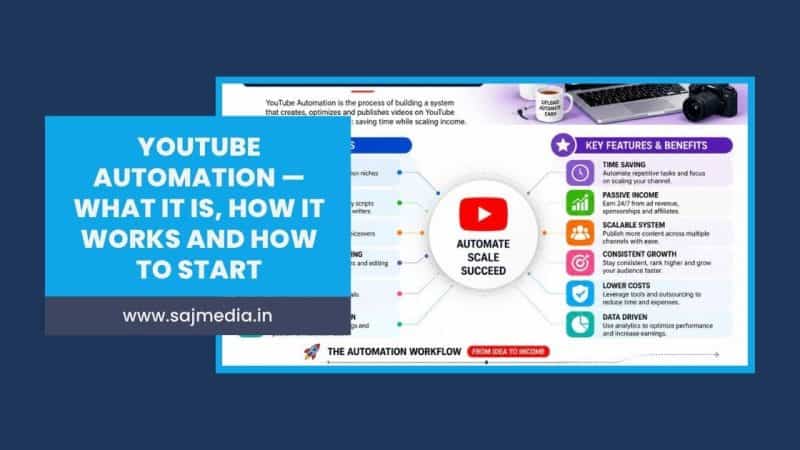
YouTube automation is the practice of running a YouTube channel without appearing on camera and without manually handling every task in the content production pipeline. Scripts, voiceovers, visuals, editing, thumbnails, and publishing are handled by a combination of AI tools, freelancers, and automated workflows. The channel owner manages the system — not individual videos.
The term covers two related but distinct things:
The business model — a faceless YouTube channel where the owner builds a content production system rather than personally creating each video. Many successful channels across niches including history, finance, technology, and true crime operate entirely without the creator on camera.
The production tools — AI and software that automate specific parts of any YouTube channel’s workflow. Automatic captions, AI voiceover, scheduled uploads, and analytics automation are used by both faceless channels and traditional creator channels to reduce production time.
In 2026, the most effective YouTube automation strategies combine both. A faceless production pipeline built on AI tools reduces the per-video time investment to a fraction of what manual production requires.
How YouTube Automation Works — The Full Pipeline
A complete YouTube automation channel operates through six production stages. Each stage can be automated, outsourced, or handled by AI — removing the creator from the bottleneck at each step.
Stage 1 — Niche and Keyword Research
Every profitable automation channel is built on a niche with consistent search demand on YouTube. Topics like personal finance, history, technology explanations, self-improvement, and true crime generate predictable search volume month after month.
Keyword research tools including VidIQ and TubeBuddy identify which specific topics within your niche have high search volume and relatively low competition — the same search intent logic that applies to blog content as described in how to make money with AI.
Stage 2 — Script Production
The script is the foundation of every video. Automated channels use one of three approaches:
AI scripting — Claude, ChatGPT, or a specialized scriptwriting tool generates a first draft based on the target keyword and topic brief. A human editor then reviews, adds specific data and sources, and refines the tone before the script is finalized.
Freelance scriptwriting — A contracted writer produces scripts from a brief and style guide. This produces more natural, authoritative content but costs more per video.
Hybrid — AI generates the structure and bulk content; a human editor adds expertise, personality, and fact-checks the output. This is the most common approach for quality-conscious automation channels.
As covered in the AI writing tools guide, Claude consistently produces the most natural long-form prose for scripted video content — making it the strongest AI scripting tool for automation channels that prioritize output quality.
Stage 3 — Voiceover Production
Faceless channels use AI-generated voiceovers rather than recording a human narrator. The quality of AI voiceover has improved dramatically. ElevenLabs produces natural-sounding narration in dozens of voices and accents — indistinguishable from human recording for most viewers on standard listening equipment.
The cost per video for AI voiceover is under $1 at most production volumes — compared to $50 to $200 per video for a freelance human voice actor. This is the cost reduction that makes the YouTube automation model economically viable at scale.
Stage 4 — Visual Production
Faceless channels use one of several visual formats:
Stock footage compilations — Licensed stock video from platforms including Pexels, Pixabay, and Storyblocks assembled to match the script narration. This is the most common format for history, nature, and documentary-style channels.
AI-generated visuals — AI video generators including Kling, Runway, and Higgsfield produce custom visuals from text prompts. The quality in 2026 is sufficient for many niches where photorealistic human footage is not required.
Screen recordings and slideshows — Finance, technology, and tutorial channels frequently use screen recordings with narration overlay. These require minimal visual production skill and scale easily.
Stage 5 — Editing and Post-Production
Video editing is the most time-consuming stage of traditional YouTube production. Automation channels reduce this using template-based editing workflows — a fixed structure that editors apply to each video without redesigning the format.
CapCut, DaVinci Resolve, and Adobe Premiere Pro all support template-based workflows. Automatic captions can be generated by CapCut or Descript in minutes rather than hours of manual transcription.
Stage 6 — Thumbnail Creation and Publishing
Thumbnails follow a consistent template — same font, same color scheme, same layout logic — that differentiates the channel visually and reduces design time per video. Canva’s automation features allow batch thumbnail creation across multiple videos simultaneously.
Scheduled publishing — uploading completed videos and setting future publish dates — means a full week of content can be queued in a single session. Most successful automation channels batch-produce four to eight videos per production session and publish one to two per week on a consistent schedule.
What YouTube Automation Actually Earns
YouTube automation channel income comes from the same sources as any YouTube channel — but the business model changes the economics significantly.
YouTube AdSense — The primary income source for most automation channels. Finance, business, and technology niches earn the highest CPM rates — $8 to $45 per 1,000 views depending on audience location and topic. A channel generating 500,000 monthly views in the finance niche earns approximately $4,000 to $22,500 per month from AdSense alone.
Affiliate marketing — Automation channels in technology, software, and finance niches naturally integrate affiliate recommendations. A finance channel recommending investment platforms or a tech channel reviewing software tools earns commission on purchases driven by video content.
Sponsorships — Channels with consistent viewership in high-value niches attract brand sponsorships. At 50,000 to 100,000 subscribers with strong engagement, automation channels regularly command $500 to $5,000 per sponsored segment.
Digital products — Courses, templates, and guides related to the channel’s niche produce income independent of AdSense rates and algorithm changes.
Realistic income timeline:
| Stage | Subscribers | Monthly Views | Estimated Monthly Income |
|---|---|---|---|
| Starting out | Under 1,000 | Under 10,000 | $0 — not yet monetized |
| Early growth | 1,000 to 10,000 | 50,000 to 150,000 | $100 to $800 |
| Established | 10,000 to 100,000 | 200,000 to 800,000 | $1,000 to $8,000 |
| Scaled | 100,000+ | 1M+ | $5,000 to $50,000+ |
These figures assume a mid-to-high CPM niche. Low-CPM niches like entertainment and gaming earn significantly less at the same view counts. The content creator salary guide covers platform payout rates across niches in detail.
How to Start a YouTube Automation Channel — Step by Step
Step 1 — Choose a Profitable Niche
The niche determines your CPM rate, your competition level, and how easy it is to consistently produce content without being an on-camera expert. The strongest niches for automation channels combine consistent search demand, high advertiser CPM rates, and content that can be produced credibly without the creator’s personal presence.
Top niches for YouTube automation in 2026: personal finance and investing, history and true crime, technology and AI explanations, self-improvement and productivity, business and entrepreneurship, health and wellness (factual educational content).
Step 2 — Research Your Competition
Before producing a single video, analyze the top channels in your chosen niche. Identify what topics they cover, how frequently they post, what their thumbnail style looks like, and how many views their recent videos are getting.
Look for gaps — topics with clear search demand that the major channels have not recently covered. These represent your lowest-competition opportunities.
Step 3 — Build Your Production Toolkit
A minimum viable YouTube automation toolkit in 2026:
- Scripting — Claude or ChatGPT free tier
- Voiceover — ElevenLabs free tier (10,000 characters per month)
- Visuals — Pexels and Pixabay for free stock footage
- Editing — CapCut free tier with auto-captions
- Thumbnails — Canva free plan
- Analytics — VidIQ free tier
Total starting cost using free tiers: $0. As your channel grows and revenue covers costs, upgrade the tools that create the most bottlenecks first.
Step 4 — Produce Your First Ten Videos
The first ten videos teach you more about your workflow than any amount of planning. Produce them as efficiently as possible — do not obsess over perfection. Upload consistently and let the YouTube algorithm begin testing your content.
Focus on hitting the YouTube monetization requirements — 1,000 subscribers and 4,000 watch hours — as your first milestone. These are achievable within six to twelve months for channels posting one to two videos per week in a well-chosen niche.
Step 5 — Optimize Based on Analytics
After uploading your first ten videos, review your YouTube Studio analytics. Which videos have the highest click-through rate on thumbnails? Which have the highest completion rate?
Double down on the formats, topics, and thumbnail styles that perform best. Eliminate or significantly revise formats that consistently underperform.
Common YouTube Automation Mistakes
Choosing a saturated niche without a differentiating angle. Finance and history channels are profitable but competitive. New automation channels that produce the same content as established channels with hundreds of thousands of subscribers will struggle to gain traction. Find a specific sub-niche angle — personal finance for freelancers, history of technology, AI tool explanations for non-technical audiences.
Prioritizing quantity over quality. Posting daily with thin, poorly researched content consistently underperforms posting twice per week with well-researched, well-produced videos. YouTube’s algorithm rewards watch time and completion rate — both of which require content worth watching to the end.
Using obvious AI voiceover without editing. Raw AI voiceover from any tool requires editing — adjusting pace, correcting pronunciation of unusual words, and adding natural variation. Unedited AI narration is identifiable and consistently produces lower completion rates.
Neglecting thumbnails. The thumbnail determines whether someone clicks. A strong video with a weak thumbnail gets fewer clicks than a weaker video with a compelling thumbnail. Invest proportionally in thumbnail quality — it is the highest-leverage visual in your channel’s production.
FAQ
YouTube automation is running a YouTube channel without appearing on camera and without manually handling every production task. Scripts, voiceovers, visuals, editing, and publishing are handled by AI tools, freelancers, and automated workflows. The channel owner manages the production system rather than personally creating each video.
Yes. YouTube automation does not violate YouTube’s terms of service. Using AI tools, freelancers, and outsourced production is entirely permitted. The content itself must comply with YouTube’s community guidelines and copyright policies — which applies to all channels regardless of how content is produced.
Income varies widely by niche, view count, and monetization strategy. Established automation channels in high-CPM niches like finance and technology with 100,000 to 500,000 monthly views can earn $2,000 to $20,000 per month from AdSense alone. Adding affiliate marketing, sponsorships, and digital products significantly increases total income.
Most automation channels reach the 1,000 subscriber and 4,000 watch hour thresholds for YouTube Partner Program eligibility within six to eighteen months of posting one to two videos per week. Niche selection, content quality, and upload consistency are the primary factors affecting timeline.
No — free tiers from Claude or ChatGPT for scripting, ElevenLabs for voiceover, Pexels for stock footage, CapCut for editing, and Canva for thumbnails cover the full production workflow at zero cost. Paid upgrades become worthwhile after the channel generates sufficient revenue to justify the investment.
Personal finance, investing, history, true crime, technology explanations, self-improvement, and business consistently deliver the strongest combination of search demand, advertiser CPM rates, and content that can be produced without the creator on camera. Avoid entertainment and gaming niches for automation — lower CPM rates make the economics less favorable.
Conclusion
YouTube automation is a legitimate business model that allows creators to build scalable content operations without being on camera. The combination of AI tools, structured workflows, and consistent publishing creates channels that grow and generate income independent of the creator’s daily availability.
Start with niche research. Build a free toolkit using Claude, ElevenLabs, CapCut, and Canva. Produce your first ten videos. Optimize based on what the analytics show. Apply for monetization when you hit the YouTube monetization requirements.
The most successful automation channels are not successful because they are automated. They are successful because the content is genuinely useful and consistently delivered. Automation removes the bottlenecks. Content quality and niche selection determine whether the channel grows.




Leave a Comment
Your email address will not be published. Required fields are marked *