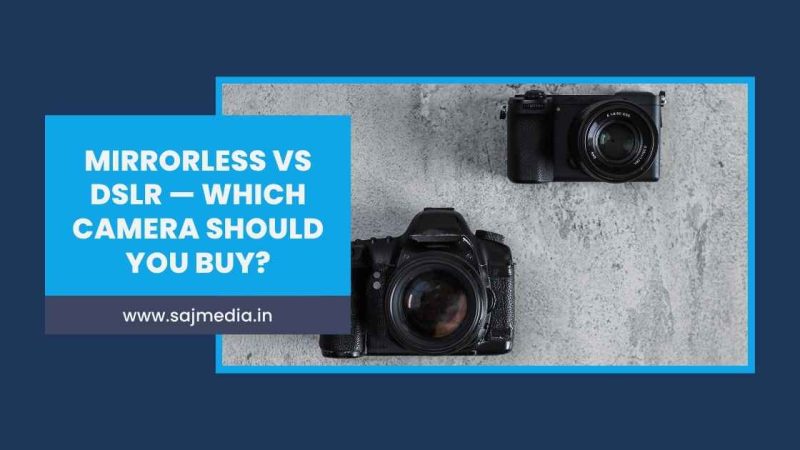
Mirrorless vs DSLR — in 2020 this was a genuine debate. Today it is mostly settled. However, the answer still depends entirely on who is asking.
For most people buying a camera for the first time or upgrading in 2026, the mirrorless vs DSLR question has a clear answer. Nevertheless, DSLRs still make practical sense in specific situations — and understanding why will help you make a smarter buying decision than simply following what everyone else is doing.
This guide covers the real differences between mirrorless and DSLR cameras across every factor that matters — autofocus, video, battery life, size, lens options, and price — and gives you a clear recommendation based on what you actually need.
What Is the Difference Between Mirrorless and DSLR?
The fundamental difference is mechanical. A DSLR — Digital Single Lens Reflex — uses a physical mirror inside the camera body that reflects light up into an optical viewfinder. When you press the shutter, the mirror flips up and the sensor captures the image.
A mirrorless camera removes the mirror entirely. Light travels directly from the lens to the sensor, which feeds a live image to an electronic viewfinder or rear screen in real time. This design change affects nearly every aspect of how the camera performs — from autofocus speed to video capability to the size of the body.
According to Canon’s own comparison of the systems, the absence of a mirror mechanism is what enables mirrorless cameras to preview exposure, white balance, and depth of field in real time through the viewfinder — something an optical viewfinder cannot do.
Mirrorless vs DSLR — Key Differences Compared
Autofocus
Mirrorless cameras have a decisive advantage in autofocus, particularly for video and moving subjects. Because the sensor is always exposed to light, mirrorless systems can use phase-detect autofocus across the entire sensor area. Modern cameras from Sony, Canon, and Nikon use AI-driven subject recognition that tracks eyes, faces, animals, and vehicles with accuracy that was impossible even three years ago.
DSLRs use a dedicated autofocus module separate from the main sensor — which historically gave them an advantage in low light and during fast action. However, modern mirrorless systems have closed this gap significantly. Furthermore, DSLRs switch to a slower contrast-detect system when shooting video in live view, which produces the characteristic “hunting” behaviour visible in older video footage.
Verdict: Mirrorless wins — especially for video and subject tracking.
Video Quality
Mirrorless cameras dominate video production. Their design is fundamentally better suited to continuous live-view capture, and camera manufacturers have concentrated their video technology development almost entirely on mirrorless platforms.
The best compact cameras for vlogging — as covered in the compact vlog camera guide — are all mirrorless or gimbal-integrated designs. Standard mirrorless bodies now shoot 4K 60p with 10-bit colour, Log profiles, and in-body stabilization. Most DSLRs, even high-end models, struggle to match basic 4K implementation.
Verdict: Mirrorless wins decisively for video.
Size and Weight
Mirrorless cameras are generally smaller and lighter than equivalent DSLRs because they do not need to accommodate a mirror box, pentaprism, and secondary autofocus system. For travel, street photography, and daily carry, this is a significant practical advantage.
However, the lens size is not always proportionally smaller. Large telephoto lenses remain large regardless of the camera system. Additionally, some photographers prefer the larger grip and heavier body of a DSLR for ergonomic reasons when using heavy glass.
Verdict: Mirrorless wins on portability — with exceptions for large lens systems.
Battery Life
This is the one area where DSLRs maintain a meaningful advantage. Because DSLRs use an optical viewfinder that draws minimal power, they can achieve 1,200 or more shots per charge on mid-range bodies. Mirrorless cameras power a sensor and electronic viewfinder continuously, which consumes considerably more energy — typically 300 to 600 shots per charge.
According to independent testing by Digital Camera World, this gap has narrowed with newer mirrorless bodies but remains significant for full-day professional shooting where battery swapping is inconvenient.
Verdict: DSLRs win on battery life — carry spare batteries if you go mirrorless.
Lens Options
DSLRs have a historical advantage in lens choice — Canon EF and Nikon F mount lenses accumulated over decades provide enormous selection at every price point. However, mirrorless manufacturers have been aggressively expanding their lens ecosystems. Sony’s E-mount now exceeds 60 native lenses, with strong third-party support from Sigma and Tamron. Canon’s RF system and Nikon’s Z system are growing rapidly.
Furthermore, most mirrorless cameras can use DSLR lenses via adapters — meaning existing lens collections are not lost when switching systems.
Verdict: DSLRs have more legacy options, but mirrorless systems are catching up fast.
Price and Value
Entry-level DSLRs remain some of the best value-for-money options in the camera market. A used Canon EOS Rebel series or Nikon D3500 provides excellent image quality at a fraction of the cost of equivalent mirrorless bodies.
At the mid-range and professional levels, pricing is broadly comparable between the two systems. The real cost difference emerges in lenses — DSLR lenses are often significantly cheaper on the used market due to the shift toward mirrorless.
Verdict: DSLRs offer better value at entry level. Mirrorless is competitive at mid-range and above.
Mirrorless vs DSLR — Summary Table
| Feature | Mirrorless | DSLR |
|---|---|---|
| Autofocus | ✅ Better — AI subject tracking | ⚠️ Strong but older tech |
| Video quality | ✅ Significantly better | ❌ Limited, especially 4K |
| Size and weight | ✅ Generally lighter | ❌ Larger and heavier |
| Battery life | ❌ Shorter — 300–600 shots | ✅ Longer — 800–1500 shots |
| Lens options | ⚠️ Growing rapidly | ✅ Decades of options |
| Entry-level price | ❌ Higher | ✅ Better value |
| Future investment | ✅ All R&D focus here | ❌ Limited new development |
Who Should Buy Mirrorless
Buy a mirrorless camera if you are buying new and plan to grow with the system over several years. Mirrorless is where all manufacturer research and development is concentrated — new lenses, new bodies, new features all arrive on mirrorless platforms first and exclusively.
Additionally, if video is any part of your content creation workflow — from YouTube tutorials to social media Reels to UGC creator work for brands — mirrorless is the only practical choice in 2026.
According to a survey of professional photographers compiled by Daily Camera News, 73% of professionals now shoot primarily on mirrorless systems. That adoption rate reflects the technology advantage, not just trend-following.
Who Should Buy DSLR
Buy a DSLR if you are on a strict budget and want the best possible image quality per dollar spent. A used mid-range DSLR from Canon or Nikon delivers professional-quality stills at prices that no mirrorless equivalent can match.
Furthermore, if you already own a significant collection of DSLR lenses and shoot primarily stills — portrait, landscape, documentary — a DSLR remains entirely capable. There is no urgent need to upgrade if your current system is delivering results.
DSLRs also make sense for creators who value battery life above all else — event photographers shooting all-day without access to charging, for example.
FAQ
For most use cases in 2026 — especially video, autofocus, and future-proofing — yes. However, DSLRs offer better battery life and better value at entry-level price points. The best choice depends on your specific needs and budget.
Beginners with flexible budgets should buy mirrorless — the system is where manufacturers are investing, and the autofocus makes getting sharp images significantly easier. Budget-constrained beginners will get excellent results from an entry-level DSLR at lower cost.
Yes — most mirrorless systems support DSLR lenses via mount adapters. Canon RF bodies accept EF lenses, Nikon Z bodies accept F-mount lenses, and Sony E-mount accepts a wide range via third-party adapters. Some autofocus functionality may be limited depending on the lens and adapter.
No — DSLRs remain capable, widely used, and well-supported by manufacturers through firmware updates. However, Canon and Nikon have publicly confirmed they are no longer developing new DSLR bodies, focusing all resources on mirrorless systems instead.
Mirrorless — clearly and significantly. From 4K recording quality to autofocus during video to in-body stabilization, mirrorless cameras are purpose-built for hybrid photo-video workflows in a way that DSLRs are not.
Conclusion
The mirrorless vs DSLR debate has a clear practical answer for most people buying a camera today — mirrorless offers better technology, better video, and a better long-term investment in a system that manufacturers are actively developing.
However, DSLRs are not obsolete. They offer genuine advantages in battery life and entry-level value that mirrorless bodies cannot currently match at equivalent price points.
Buy for what you need now and where you want the system to take you. If the answer involves video, advanced autofocus, or building a kit you plan to grow over years — mirrorless is the right call. If the answer is maximum stills quality at minimum cost — a used DSLR remains one of the best deals in photography.



Leave a Comment
Your email address will not be published. Required fields are marked *