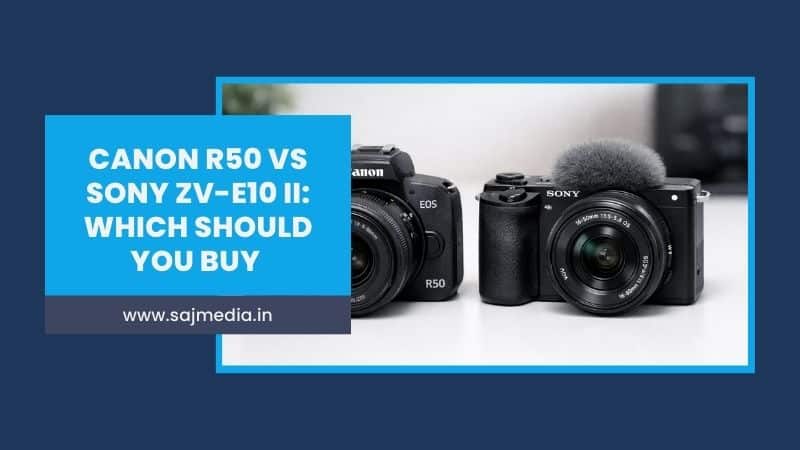
The Canon R50 and Sony ZV E10 II are two of the most popular entry-level mirrorless cameras for video creators in 2026. Both sit under $800 (approx. ₹66,500). Both have flip screens, fast autofocus, and APS-C sensors. At first glance, they look like the same camera from two different brands.
They are not the same camera. The differences between them will affect your footage every day. This comparison breaks down sensor performance, autofocus, video specs, audio, battery life, and the specific type of creator each camera suits best.
By the end, you will know exactly which one to buy.
All prices are in USD. Indian prices vary by retailer and import duties. INR figures are approximate.
Affiliate note: This article contains Amazon affiliate links. If you buy through our links, we earn a small commission at no extra cost to you.
Key Takeaways
- The ZV E10 II shoots 4K at 60fps. The R50 caps at 4K/30fps.
- The R50 produces better out-of-camera color for beginners who skip color grading.
- The ZV E10 II has S-Log3 for professional color grading workflows.
- Neither camera has in-body image stabilization. Budget for a gimbal with either one.
- The R50 suits photo-video hybrid creators. The ZV E10 II suits dedicated video creators.
Specs Comparison
| Spec | Canon R50 | Sony ZV E10 II |
| Sensor | 24.2MP APS-C CMOS | 26MP APS-C Exmor R |
| 4K Video | 4K/30fps (oversampled) | 4K/60fps |
| 1080p Video | 1080p/60fps | 1080p/120fps (slow motion) |
| Autofocus | Dual Pixel CMOS AF II | Phase-detect + AI Subject Recognition |
| Eye AF | Yes (human, animal) | Yes (human, animal, bird) |
| IBIS | No | No |
| Log Profile | Canon Log (limited) | S-Log3, S-Cinetone |
| Screen | Fully articulating | Vari-angle |
| Battery Life | Approx. 380 shots | Approx. 440 shots |
| Weight | 375g (body only) | 292g (body only) |
| Price (body) | Approx. $680 (approx. ₹56,500) | Approx. $750 (approx. ₹62,500) |
Video Quality
Canon R50
The R50 shoots 4K video at up to 30fps using oversampling from a 6K readout. The result is sharp, clean footage with good dynamic range for an entry-level camera. Colors straight from the camera look natural and warm. If you post footage without color grading, the R50 gives you results that look good immediately.
The crop factor in 4K mode is 1.56x. With the kit lens, you get a narrower field of view than you expect. This matters for vlogging where you want a wider frame. A 10-22mm or Sigma 10-18mm lens fixes the crop issue.
Sony ZV E10 II
The ZV E10 II shoots 4K at 60fps. That 60fps capability is a significant advantage for creators who want smooth motion or slow-motion 4K. The sensor reads out with minimal rolling shutter, which matters when you pan quickly or shoot handheld.
S-Log3 gives you a flat color profile with around 14 stops of dynamic range. If you color grade your footage in DaVinci Resolve or Premiere Pro, this camera gives you far more to work with in post. S-Cinetone produces cinematic colors straight from camera without grading.
Video verdict: The ZV E10 II wins on specs. 4K/60fps and S-Log3 give serious video creators more flexibility. For creators who want great footage without touching color grading, the R50 holds its own.
Autofocus Performance
Canon R50
Dual Pixel CMOS AF II is one of the best autofocus systems in this price range. It tracks subjects fast and accurately. Eye detection works reliably across most shooting conditions. Face tracking holds lock even when subjects move sideways or look away briefly.
Where the R50 struggles is in low light autofocus. Below 1 lux, the system hunts more than the ZV-E10 II. For indoor vlogging with good lighting, this is not an issue.
Sony ZV-E10 II
Sony has upgraded the ZV-E10 II with their latest AI-based subject recognition. The camera identifies humans, animals, vehicles, and birds automatically. Subject switching between multiple people in frame is faster than the R50.
Real-time tracking is sticky. Once it locks, it holds. Even in challenging light at around 0.5 lux, the ZV-E10 II maintains focus reliably. For run-and-gun vlogging where you cannot control your environment, this matters.
Autofocus verdict: Both cameras have excellent autofocus. The ZV-E10 II edges ahead in mixed lighting and multi-subject scenarios.
Audio
Both cameras have a 3.5mm microphone input. Both include a built-in directional microphone. The Sony ZV E10 II adds a multi-interface shoe for Sony accessories like the ECM-M1 shotgun microphone, which connects without cables.
For serious audio, both cameras require an external microphone. The Sony Zoom-compatible mic slot is a practical advantage for Sony accessory users. Canon R50 owners will use a standard cold shoe mount with a cable.
Battery Life and Portability
The Sony ZV E10 II uses the NP-FZ100 battery shared across Sony full-frame cameras like the A7 series. You get around 440 shots per charge, and replacement batteries are widely available. The camera body weighs 292g, lighter than the R50.
The Canon R50 uses the LP-E17 battery rated for around 380 shots. The body weighs 375g. The R50 feels more substantial in hand, which some creators prefer for long shooting sessions.
Which Creator Should Buy Each Camera?
Buy the Canon R50 if you:
- Create photo and video content and want one camera for both
- Want great out-of-camera color without learning color grading
- Prefer the Canon lens ecosystem (RF-S lenses are strong)
- Shoot primarily in good light conditions
- Want a camera that feels solid in hand
Buy the Sony ZV E10 II if you:
- Focus primarily on video content, especially YouTube or TikTok
- Need 4K/60fps for smooth motion or slow-motion cuts
- Plan to color grade your footage in post
- Shoot in varied and unpredictable lighting conditions
- Already own Sony lenses or accessories
Price and Value
The Canon R50 body sells for around $680. The Sony ZV E10 II body sells for around $750. The $70 (approx. ₹5,800) difference is small relative to the video spec gap. If video is your primary output, the ZV-E10 II gives you more for the money.
Kit lens bundles for both cameras are available. The Canon RF-S 18-45mm kit lens is competent for starters. The Sony E 16-50mm kit lens is compact but optically average. Both creators benefit from upgrading to a wider prime lens within 6 months.
Recommended Lens Pairings
| Camera | Recommended Lens | Use Case |
| Canon R50 | Canon RF-S 10-18mm f/4.5-6.3 | Wide vlogging, indoor |
| Canon R50 | Canon RF 50mm f/1.8 | Portraits, low light |
| Sony ZV E10 II | Sony E 10-20mm f/4 G | Wide vlogging, indoor |
| Sony ZV E10 II | Sony E 35mm f/1.8 OSS | Portraits, low light |
FAQ
No. The R50 shoots 4K at a maximum of 30fps. For 4K/60fps, you need the Sony ZV-E10 II or a higher-tier Canon body.
The ZV-E10 II does not have in-body image stabilization. Some Sony lenses have optical stabilization (OSS). For stable handheld footage, use a gimbal like the DJI OM 6.
The Canon R50 is more forgiving for beginners because its color science produces good results without post-processing. The ZV-E10 II requires more setup to get the best out of S-Log3.
Yes. The R50 is an excellent dual-use camera. Its 24.2MP sensor and Dual Pixel AF produce sharp, well-exposed photos in most conditions.
Final Verdict
Both cameras are strong choices. Your decision comes down to what you create.
Video-first creators, especially those building a YouTube or TikTok channel, get more from the ZV-E10 II. The 4K/60fps, S-Log3, and superior low-light autofocus justify the extra $70 (approx. ₹5,800).
Photo-video hybrid creators and beginners who want results without a steep learning curve get more from the Canon R50. The color science is forgiving, the autofocus is excellent, and the Canon lens ecosystem is deep.
Our pick for dedicated video creators: Sony ZV-E10 II. Our pick for photo-video hybrid creators: Canon R50.


Leave a Comment
Your email address will not be published. Required fields are marked *